


Client: MISC Offshore
Process: Sulphate Removal & Reverse Osmosis
Location: Campo de Mero Libra Block, Santos Basin - Offshore Brazil
Contact Description: Seawater Treatment Process Modules
Contract Award Date: May 2021
Contract Completion Date: October 2022
SRU Capacity: 250,737 BPD (39,864 m3/day)
RO Capacity: 12,076 BPD (1,920m3/day)
Sea Water Conversion: 75%
Sea Water Feed Quality:
- TDS: 35,200 mg/l
- Sulphate: 2,800 mg/l
Product Water Output Quality: <50 mg/l
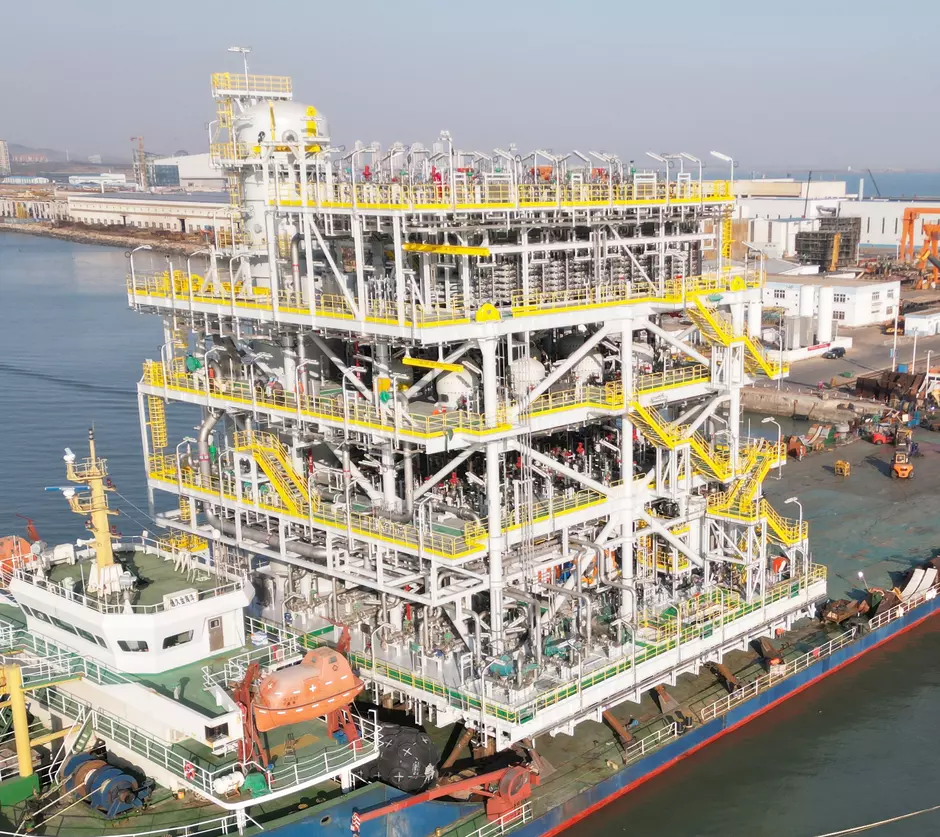
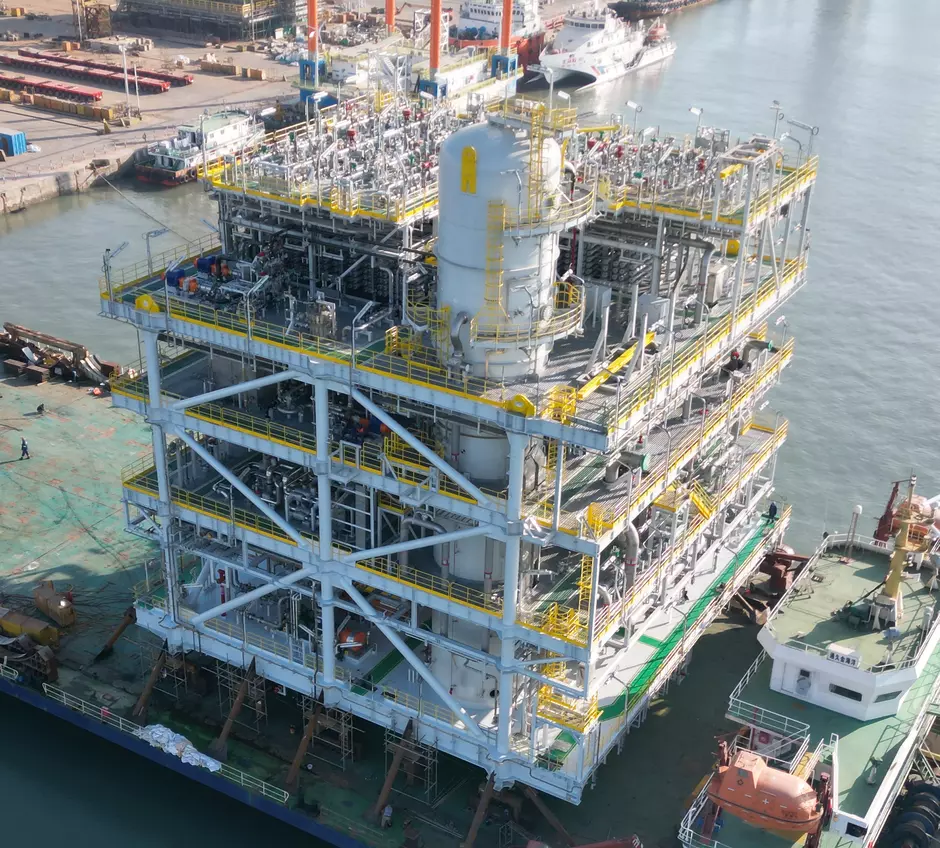
Project Description:
The design, procurement, and construction of a seawater treatment plant module comprising a 250,737 BPD (39,864 m3/day) Seawater Sulphate Removal process system, and a 12,076 BPD (1,920 m3/day) Seawater Reverse Osmosis process system, for the FPSO Marechal Duque de Caxias (MERO 3) that will operate in Campo de Mero, in the Libra Block of the Santos basin, offshore Brazil. The FPSO charter is for 22.5 years and is MISC’s first Brazilian operation, their award from Petrobras and their Mero field investment partners that include the Veolia key accounts Total (20%), and Shell (20%).
Project Scope:
The seawater treatment plant equipment scope: UltraMEV108 Ultrafiltration, SR & RO HP Feed Pumps, Sulphate Removal & Reverse Osmosis Membrane Systems, Common Clean In Place Package, UF CEB System, Vacuum Deaerator Tower and Vacuum Pump Package, Water Injection Booster Pumps, Plant Control System, Piping, Valves, and Instrumentation.
Process Description:
Seawater is pumped using the Seawater Lift Pumps (provided by others) and directed to the seawater treatment system. The raw seawater is chlorinated via the electrochlorination package (by others) and introduced into the seawater lift pump suction lines. Sodium hypochlorite is used to limit the potential of biological activity in the downstream processes. It will also be dosed into the UF trains during Chemically Enhanced Backwash.
Automatic backwashable seawater coarse strainers remove larger particulate matter from the feed stream to the SRU plant. The filtered seawater from seawater coarse strainers is used as source water for the water injection system.
The feed stream is directed to UF pre-treatment. The UF Membrane System treats the SRU feed water to remove the majority of particles. The process uses Dow hollow fibre membrane technology in ‘dead-end’ filtration mode without the need for continuous cross flow velocity. The filtrate quality is typically expected to have an SDI < 3.
The UF filtrate is routed to Reverse Osmosis package (secondary source) or to the suction of the Sulphate Removal Unit Feed Pumps to boost the conditioned water to the required feed pressure for the membranes. The SR Feed Pumps operate in parallel. Antiscalant is dosed downstream of the Sulphate Removal Feed Pumps, decreasing the scaling tendency by limiting the formation of sparingly soluble salts in the membrane system. SBS is also dosed into common discharge piping of the Sulphate Removal Feed Pumps to remove the residual chlorine present in the seawater to prevent irreparable damage to the SR90 membranes. Finally a non-oxidizing proprietary biocide for treating the SR90 membranes is also periodically batch dosed into the same location.
The seawater flows to parallel operated Sulphate Removal Units. To achieve the specified sulphate level both stages will be fitted with Dow Filmtec type SR90-440i membranes.
The feed pressure to each SRU is controlled based on the permeate flow set point. The SRU produces 75% of the feed flow as low sulphate permeate Seawater. The low sulphate SW from each SRU is merged and then directed to the deaerator. The remaining 25% of the feed flow ends up as high sulphate content reject seawater and is directed overboard.
SRU trains are provided with automatic full and partial bypass that may be used during SRP membrane cleaning.
The treated seawater then enters the Vacuum Deaerator to remove dissolved oxygen from the water. Oxygen scavenger is dosed to the sump of the deaerator to chemically reduce the remaining oxygen further to the required levels.
Deaerated, low sulphate injection water from the deaerator is routed to water injection booster pumps. These pumps are provided to boost the feed pressure to the required pressure at the package boundary. The Deaerator tower is provided with manual bypass and additional dosing point for Oxygen Scavenger in case the Deaerator operates in bypass mode. Biocide (DBNPA) dosing points are also provided upstream and downstream of the Deaerator and can be batch dosed for sanitation purposes . Additionally Biocide (THPS) dosing point is provided upstream of the Deaerator Tower. This can only be used when the RO system (by others) is not fed from the Deaerator.
There is a membrane cleaning in Place (CIP) system for the SR and UF trains. The CIP Tanks capacity is designed for the 1st stage of SR membranes or 1 train of UF membranes wash (if applicable). CIP Pumps and cartridge filter are designed for cleaning of 1st stage of 1 SRP train (maximum capacity). One CIP Heater is provided for each CIP tank and is sized to heat up cleaning solution volume within 2 hours. Each CIP tank volume is sufficient to wash 1 membrane train (largest consumption - UF or SRP).
Chemically Enhanced Backwash (CEB) system comprises of CEB tank and pumps and allows to reuse the hypochlorite used for UF CEB clean and minimise the usage of this chemical as well as facilitates its neutralisation before disposing to overboard.